DNA replication is the biological process by which DNA is duplicated before cell division, ensuring that each daughter cell receives an identical copy of genetic material.
- Occurs during the S (synthesis) phase of interphase
- Produces two identical DNA molecules
- Each new DNA molecule contains one original strand and one newly synthesized strand
- Replication begins at specific DNA sequences called origins of replication
- DNA unwinds to form a replication bubble
- Each bubble has two replication forks, where new DNA synthesis occurs
- Prokaryotes → usually one origin (single bubble)
- Eukaryotes → multiple origins (many bubbles)

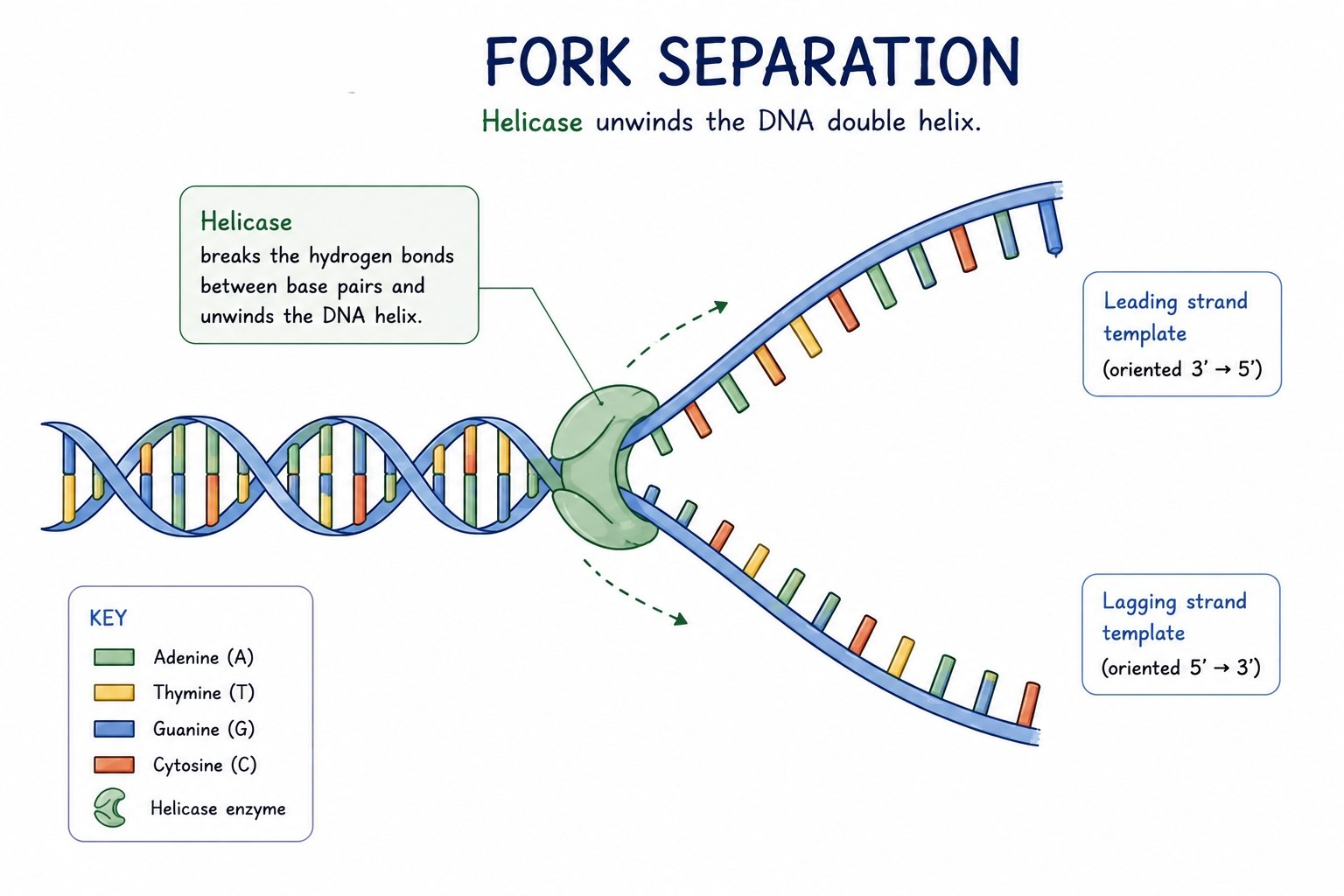
- Unwinds DNA double helix
- Breaks hydrogen bonds between base pairs
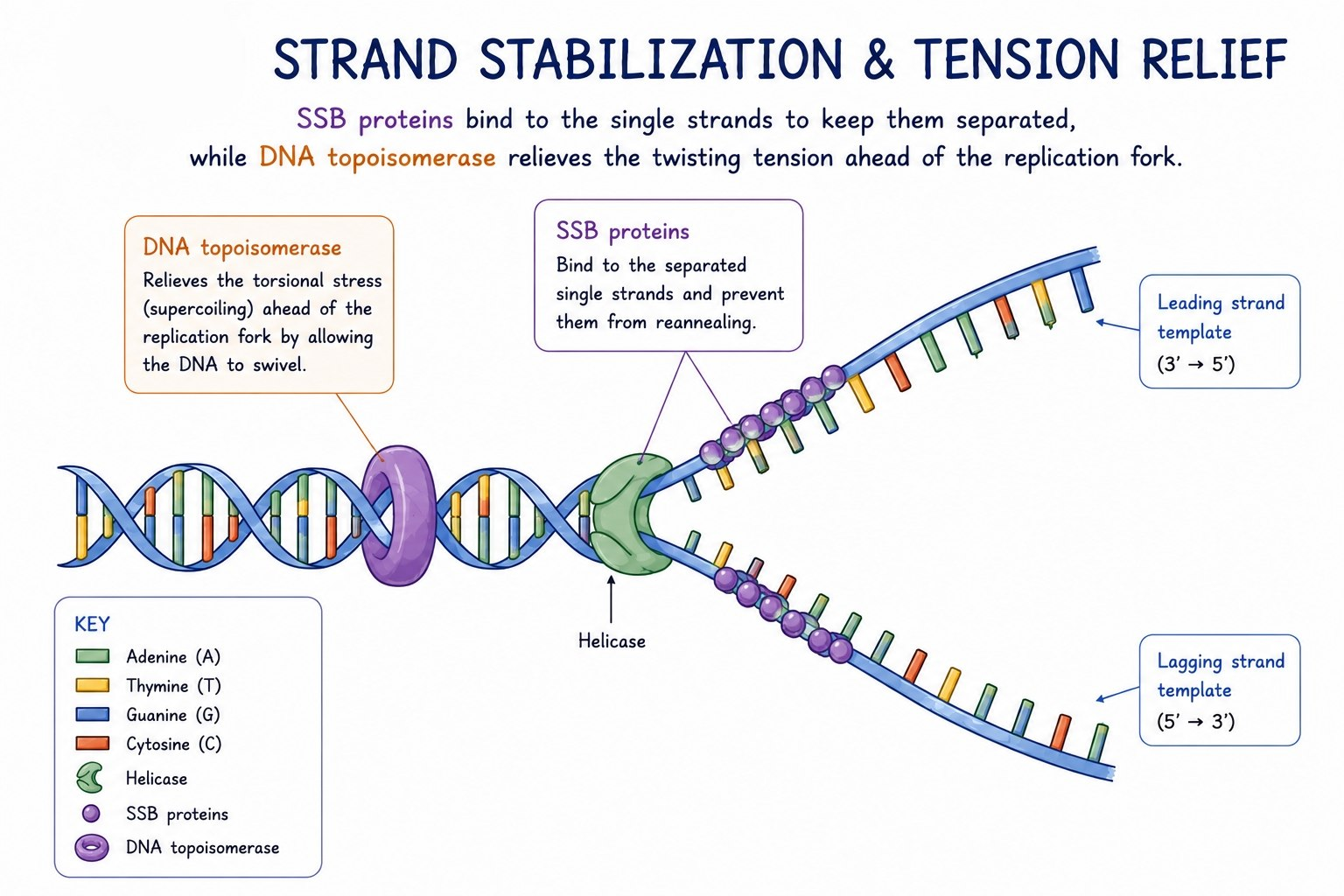
- Bind to separated DNA strands
- Prevent re-annealing and formation of secondary structures
- Protect DNA from degradation
- Relieves torsional stress and supercoiling ahead of replication fork
- Prevents DNA tangling
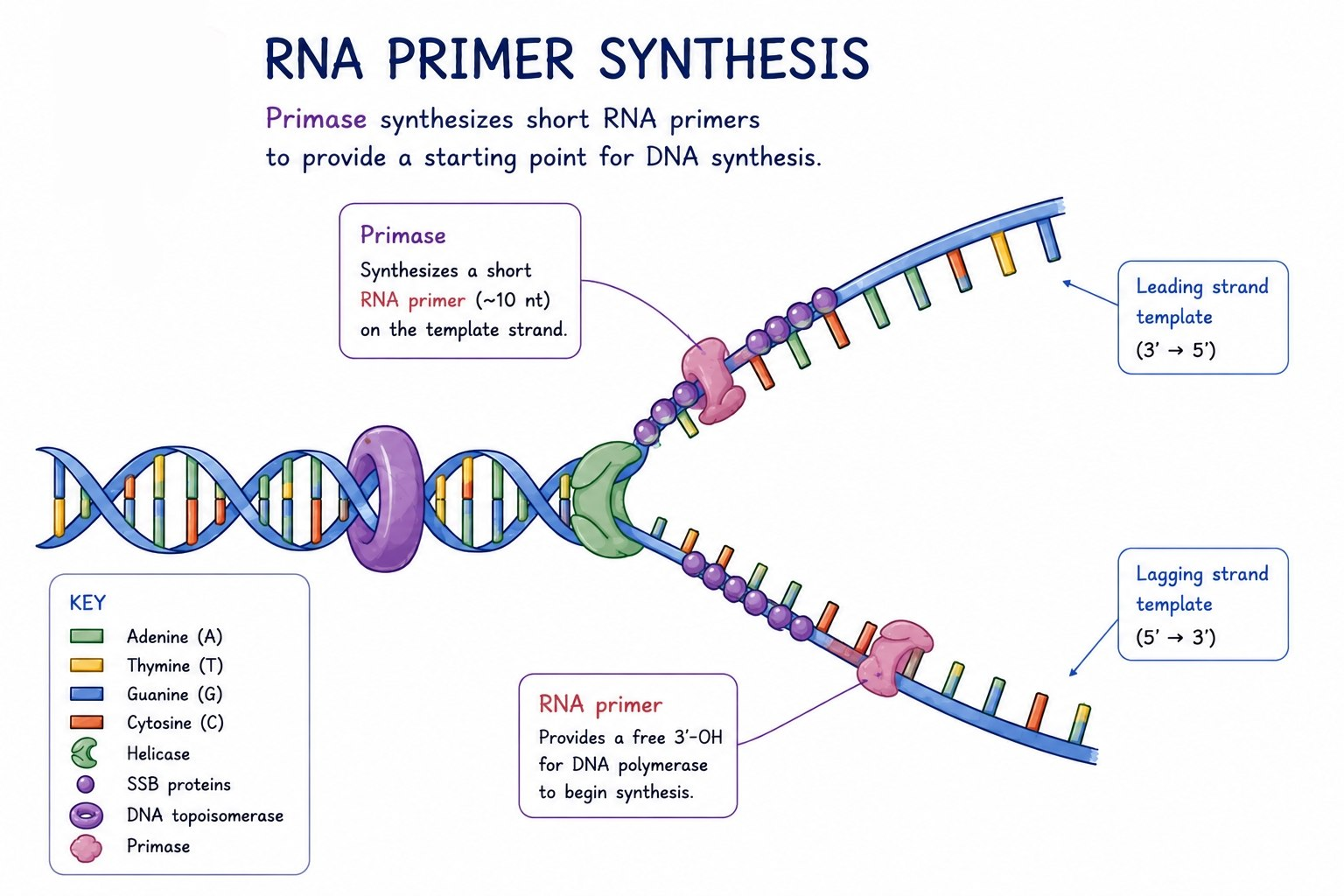
- Synthesizes a short RNA primer (~5–10 nucleotides)
- Provides a free 3′-OH group for DNA polymerase
- Adds nucleotides in the 5′ → 3′ direction, Requires: -Template strand -RNA primer -Deoxyribonucleotide triphosphates (dNTPs)
- DNA polymerase α → initiation (primer extension)
- DNA polymerase δ → lagging strand synthesis
- DNA polymerase ε → leading strand synthesis
- DNA polymerase γ → mitochondrial DNA replication
- DNA polymerase β → DNA repair
- Proofreading function of DNA polymerase
- Removes: Incorrect nucleotides & RNA primers
- Plays a role in DNA repair
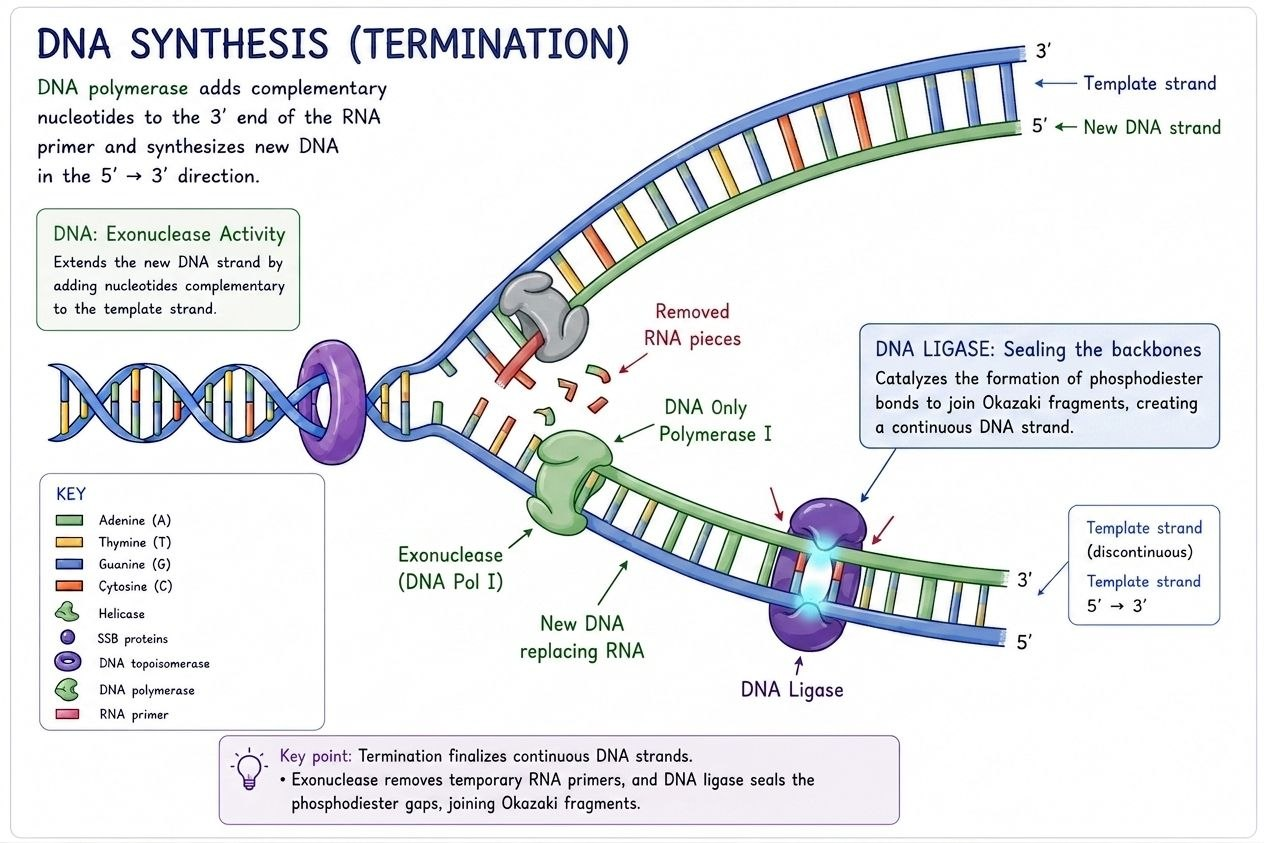
- Joins DNA fragments by forming phosphodiester bonds
- Seals gaps in the sugar-phosphate backbone
DNA replication is a coordinated, multistep process that ensures accurate duplication of genetic material. It can be divided into three main phases: initiation, elongation, and termination.
DNA helicase:
- unwinds the double helix by breaking hydrogen bonds between base pairs, This process requires ATP.
Single-stranded DNA-binding proteins (SSBPs):
- Bind to separated strands
- Prevent re-annealing
- Protect DNA from nucleases and secondary structure formation DNA topoisomerases:
- Relieve torsional stress and supercoiling ahead of the replication fork
- Prevent over winding of DNA
- DNA primase synthesizes a short RNA primer (~5–10 nucleotides)
- Primer is:
- Complementary to the DNA template
- Antiparallel in orientation
- Provides a free 3′-OH group required for DNA synthesis
- Primase functions as part of the primosome complex (helicase + primase)
- RNA primers are especially important on the lagging strand, where multiple primers are required
- DNA polymerase adds nucleotides using deoxyribonucleotide triphosphates (dNTPs).
- Synthesis occurs only in the 5′ → 3′ direction.
- Note:- DNA synthesis can be inhibited by agents such as cytosine arabinoside (Ara-C), which interferes with nucleotide incorporation.
- Leading strand: Synthesized continuously toward the replication fork.
- Lagging strand: Synthesized discontinuously away from the fork, Forms short segments called Okazaki fragments.
Okazaki fragments are short DNA segments synthesized discontinuously on the lagging strand.
- Formed because DNA polymerase works only in the 5′ → 3′ direction
- Later joined by DNA ligase to form a continuous strand

- Replication ends when replication forks meet
- RNA primers are removed by exonuclease activity of DNA polymerase
- Gaps are filled with DNA nucleotides
- DNA ligase forms phosphodiester bonds
- Joins Okazaki fragments into a continuous strand
- DNA polymerase makes approximately 1 error per 10⁴ base pairs
- Proofreading and repair mechanisms reduce error rate to approximately: 1 in 10⁹ base pairs
This ensures high fidelity of DNA replication.
Semiconservative: each daughter DNA contains:
- One parental strand
- One newly synthesized strand
Antiparallel: DNA strands run in opposite directions (5′ → 3′ and 3′ → 5′)
Semi discontinuous:
- Leading strand is synthesized continuously
- Lagging strand is synthesized discontinuously
Bidirectional:
- Replication proceeds in both directions from the origin
- DNA repair mechanisms: correct post-replication errors
- Reverse transcriptase: synthesizes DNA from RNA template (important in retroviruses)
- Post-replication modifications: ensure DNA stability and functionality